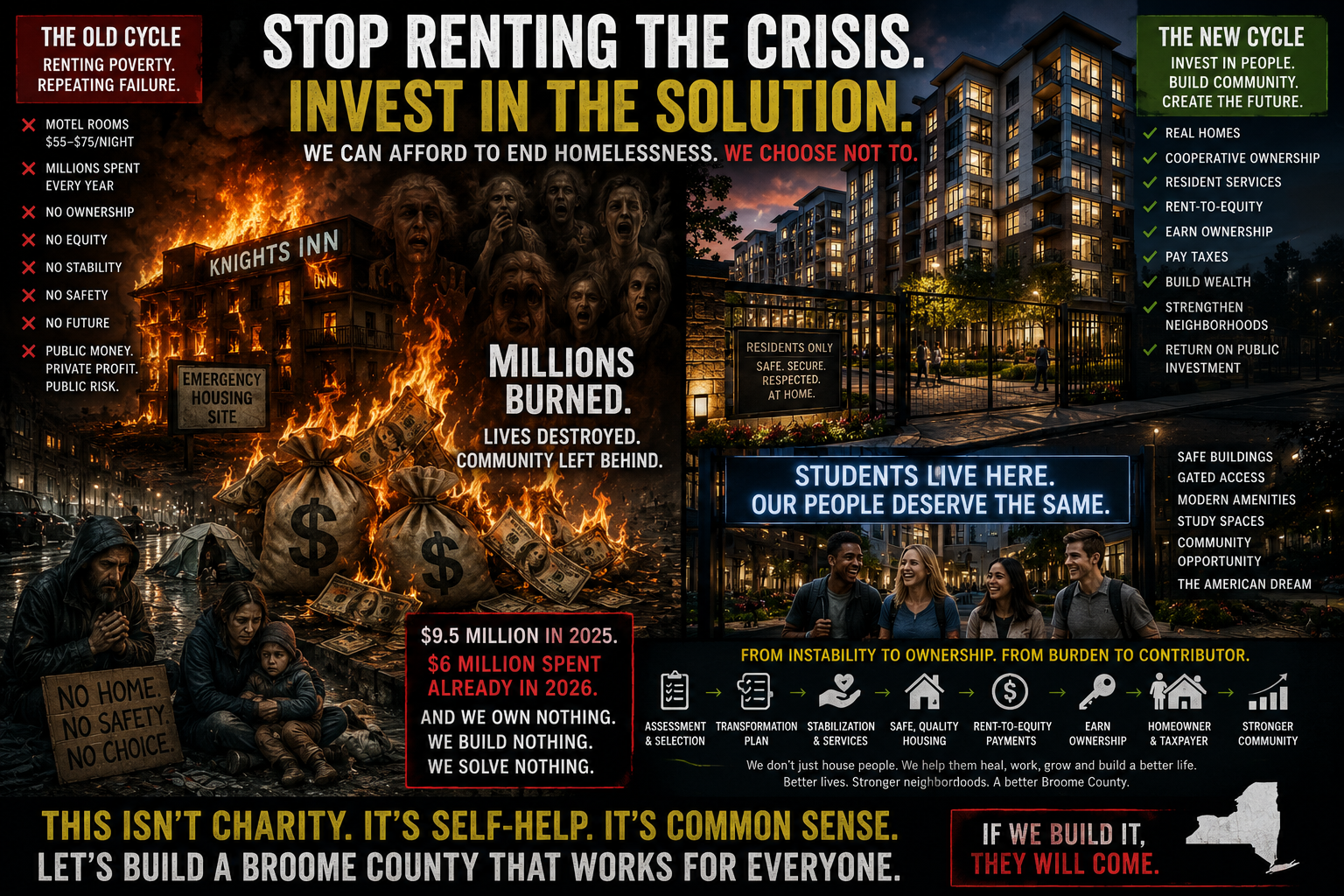
Stop Renting the Crisis and Invest in the Solution
By R.D. Milano, Publisher, NewsXR and MyBroome.com
Six people are dead after the Knights Inn fire in Endwell. That sentence should stop Broome County cold. The criminal case will move forward. A 24-year-old Endwell man, Tyler J. Russell, has been charged with six counts of second-degree manslaughter and one count of fourth-degree arson. If prosecutors prove their case, accountability must follow. But this cannot become only an arson story.
The fire at the Knights Inn sits inside a larger local failure that Broome County can no longer manage around, explain away, or rent its way through. This is about homelessness. It is about poverty. It is about people who are poor but housed. It is about public money. It is about emergency housing. It is about motel placements. It is about long-term rental assistance. It is about vacant and abandoned properties. It is about working families one missed paycheck away from collapse. It is about local government choosing temporary containment over permanent housing. And it is about whether Broome County will keep paying to shuffle people through crisis, or finally start using that money to build exits out of poverty.
When Broome County pays for temporary housing instead of permanent housing investments, it does not only make homeless residents temporary motel guests. It makes Broome County a permanent renter in its own failure. The county already knows the motel system is broken. County officials have publicly acknowledged the need to reduce or end reliance on hotels and motels for emergency shelter. Broome County has opened an RFP seeking alternatives to the current emergency housing system. The county itself has said hotel and motel placements are expensive, lack support systems, and do not create the stability needed to move people into long-term housing. That is not a theory from the outside. That is the county admitting the model does not work.
The numbers prove it. Broome County reportedly spent about $358,000 on hotel placements in 2018. By 2025, that number had exploded to about $9.5 million. WBNG reported that in 2026 alone, DSS had already spent about $6 million on motel housing by late May. That is not a budget line drifting upward. That is a system eating public money at emergency speed. At the same time, a regional point-in-time count showed homelessness across the Southern Tier climbing from 317 people in 2020 to more than 1,000 by 2025. Local housing advocates have also pointed to nearly 2,000 people seeking shelter in Broome County in 2023 when emergency shelters and contracted hotel rooms are included. This is not temporary, stable, affordable, or safe enough, and after the Knights Inn fire, nobody should be comfortable pretending otherwise.
And now the public emergency is even worse. Before the Knights Inn fire, Broome County was already relying on an expensive and unstable motel system to absorb homelessness and emergency housing need. After the fire, one of the very properties used in that emergency system is gone, six people are dead, survivors have been displaced again, and the county is left scrambling inside the same broken model with even less capacity than before. That is the danger of building an emergency housing system around private motel rooms. The county does not control the asset. The public does not own the rooms. The residents do not gain stability. And when the building is lost, the public is left with the crisis, the trauma, the displacement, and the bill, but not a single permanent housing unit to show for the money already spent.
The Knights Inn fire did not only expose the human danger of the motel model. It exposed the structural danger. Broome County was already paying millions into a temporary system that could not solve the problem. Now that system has suffered a catastrophic loss, and the need has not disappeared. It has grown sharper, more urgent, and more expensive. That is why this cannot be treated as a normal budget problem or a temporary shelter shortage. This is a public emergency made worse by the failure of the very emergency housing system the county was using to manage it.
But the larger issue is not only the people already classified as homeless. Binghamton has a poverty problem with walls around it. The Census Bureau lists Binghamton’s poverty rate at 32.6%, with a median household income of $45,578. Broome County’s own Housing Needs Assessment found that 45% of county households have incomes under $50,000, more than 13% of the population lives in poverty, and 12% of housing units are vacant. That means the crisis is not only visible under bridges, in shelters, or in motel rooms. It is inside apartments where families are barely holding on. It is inside unsafe rentals. It is inside overcrowded homes. It is inside households where rent, addiction, disability, unemployment, untreated mental illness, transportation problems, childcare, criminal records, and low wages all collide.
A person can be housed and still be trapped. A family can have an address and still be living one crisis away from DSS. A working parent can be doing everything right and still be unable to afford safe housing. An elderly resident can be housed and still be stuck in a dangerous building because moving is financially impossible. A disabled resident can have shelter and still have no accessible, stable, dignified place to live. If this policy conversation only looks at the people already in motel rooms, it misses the people headed there next.
The same logic applies beyond motel rooms. Broome County and the housing-assistance system are not only paying for emergency shelter. Public dollars also help support long-term apartment rentals for low-income housed residents through rental assistance, vouchers, public assistance, shelter allowances, and other housing supports. Those programs are necessary because people need a roof over their heads right now. But the larger question remains the same: how much public money is flowing every month into private rentals without creating ownership, public equity, restored property, new housing stock, or permanent exits from poverty?
A low-income family receiving rental assistance may be housed, but that does not mean the family is secure. The rent may be subsidized. The landlord may be paid. The household may avoid homelessness for the moment. But if the family remains one missed recertification, one rent increase, one landlord decision, one job loss, one relapse, one medical crisis, or one eviction notice away from collapse, the public has not solved the problem. It has temporarily stabilized the payment.
Long-term rental assistance can become another form of permanent public renting if it is not connected to a larger transformation plan. The public pays. The tenant survives. The landlord receives rent. But the family builds no equity, the public owns no asset, and the region remains stuck with the same shortage, the same instability, and the same bottom-of-the-market pressure. This does not mean ending rental assistance. It means improving the purpose of it. Rental assistance should be part of the ladder, not the ceiling. For some households, long-term affordable rental housing will remain the right answer. For others, the same public dollars now used to keep families barely housed should be connected to cooperative ownership, rent-to-equity apartments, rehabilitated homes, resident services, and a path that eventually turns assisted residents into owners, taxpayers, and stable neighbors.
That is the larger failure of the current system. It rents poverty year after year. It pays for motel rooms. It pays toward apartments. It pays to prevent immediate collapse. But too often it does not build a route out. NewsXR is arguing that public housing dollars should do more than keep people housed today. They should be designed to change where those families are five years from now.
The Knights Inn was not just a motel. It was part of the local emergency housing system. Broome County DSS relied on hotels and motels like it to place individuals and families experiencing homelessness when other shelter options were full or unavailable. That means the county was not simply buying rooms. It was using a private motel as part of a public safety net. That changes the question. The question is no longer only whether a private motel had a bad outcome. The question is whether public officials placed vulnerable people into a private motel system without building the safety, staffing, services, inspections, evacuation planning, and accountability that should come with housing people who have nowhere else to go.
Public reporting has already shown serious warning signs at the Knights Inn long before the fire. ProPublica and New York Focus reported that inspections from 2018 to 2021 documented problems such as missing lights, broken lamps, damaged walls, broken or unsecured doors and windows, torn carpets, and cockroaches, while Broome County continued placing social-services cases there and the motel earned more than $750,000. Spectrum later reported that Broome County paid the hotel $734,374 between April 2024 and March 2025 and that FOIL data showed 263 dispatch calls to the address in 2025 and 266 in 2024. That is not an invisible property. That is a known property. A used property. A publicly funded property. A property repeatedly connected to government placements, emergency calls, public money, and vulnerable residents. Now six people are dead.
This is why the motel model cannot be the future. Broome County cannot continue paying millions of dollars each year to private motel operators while residents remain trapped in instability and local taxpayers receive no permanent housing asset in return. Every night paid in a motel room is a night of shelter, but it is not a step toward ownership. It is not a new unit. It is not a repaired home. It is not a stabilized block. It is not a family building equity. It is not a neighborhood being restored. It is a receipt, and then the next night requires another receipt. That is the trap.
At $55 to $75 per room per night, the public can spend thousands of dollars per month to keep one household in temporary placement without creating a single permanent housing unit. Multiply that by dozens or hundreds of placements, month after month, year after year, and the county is no longer solving homelessness. It is financing homelessness management. The difference between motel spending and housing investment is simple. A motel dollar disappears when the night ends. A housing dollar can become a roof, a deed, a rental unit, a repaired home, a taxable property, a safer block, and a permanent exit from crisis.
The cost comparison cannot stop at hotels and motels. Broome County also has to look at the full public housing-payment ecosystem: emergency motel placements, shelter allowances, rental assistance, vouchers, subsidized apartments, eviction-prevention payments, back-rent assistance, code-enforcement costs, abandoned-property costs, public-safety calls, and the social-service costs that come from keeping families unstable. When those dollars are separated into different budget lines, the crisis looks smaller than it is. But to the taxpayer, it is one system. Public money is already being spent to house people, prevent homelessness, respond to homelessness, manage unsafe properties, respond to emergency calls, and clean up the damage left by housing instability. The question is whether that money keeps renting the crisis or starts building the solution.
If public dollars are going to pay rent anyway, then Broome County should ask how many of those dollars can be redirected, leveraged, matched, or structured into permanent housing assets. A portion will still need to pay for immediate shelter and rental support. But the long-term goal should be clear: every possible dollar should move the region toward more housing units, more resident stability, more public value, more ownership, more tax base, and less dependence on emergency payments.
Broome County already has part of the answer sitting in plain sight: abandoned houses, vacant buildings, tax-foreclosed homes, empty lots, and underused properties that are currently doing nothing but spreading decay. Vacant properties are not just neighborhood eyesores. They are lost tax revenue. They are public maintenance costs. They are code-enforcement burdens. They are fire risks. They are magnets for blight, crime, illegal dumping, and neighborhood decline. They pull down nearby property values and tell working families that nobody is coming to fix the block. A boarded-up house is not neutral. An empty lot is not neutral. A tax-delinquent property that sits for years is not neutral. Every dead property is a local policy failure waiting either to become a home or become more decay.
Renewing these properties would do more than create housing. It would make Broome County more attractive. It would rebuild neighborhoods. It would strengthen blocks that have been slowly losing value, pride, and population. It would give working families a reason to stay, new residents a reason to come, and struggling residents a reason to believe there is still a path forward here. That is the key to breaking the cycle of decline. Because the housing crisis is not only about people without homes. It is also about neighborhoods losing value, landlords stuck in repeated eviction cycles, tenants unable to stabilize, public agencies paying for temporary placement, and communities watching decay spread house by house.
One often ignored fact is that many landlords are also trapped in the cycle. They rent to people who cannot consistently pay, go through nonpayment, court, eviction, vacancy, repair, another tenant, another crisis, and another loss. That cycle does not help landlords. It does not help tenants. It does not help neighborhoods. It turns housing into a revolving door of instability. Real intervention has to break the problems underneath the missed rent: addiction, unemployment, untreated mental illness, lack of transportation, criminal records, family instability, poor credit, poverty, and the belief that nothing better is possible.
A stable home is not just shelter. It is leverage. Having a real house, a real address, and a real path to ownership is one hell of an incentive for someone to get their life together. It gives a person something to lose, something to protect, and something to build. It can turn employment from a temporary requirement into a personal mission. It can turn recovery from a court order into a reason to stay alive. It can turn poverty from an identity into a condition someone is actively climbing out of. That does not mean every person is ready for ownership. It does not mean every resident can go from homelessness to a deed. It does not mean housing alone cures addiction, mental illness, or unemployment. But it does mean the system should stop assuming people can be stabilized by being moved from room to room with no real stake in the outcome.
Some residents need supportive housing. Some need temporary housing. Some need treatment. Some need workforce placement. Some need family housing. Some need disability accommodations. Some need recovery housing. Some need rent support. Some need a chance to earn ownership over time. The system should sort people by need and pathway, not dump them all into the same motel pipeline. That also helps the broader rental market. When public intervention moves the highest-need residents into appropriate housing with support, it leaves more ordinary rental housing available to people who can afford to pay rent but are currently squeezed by shortage, instability, and market pressure. It can reduce landlord losses, reduce eviction volume, reduce neighborhood churn, and create a healthier rental environment for everyone.
That is what real housing policy should do. It should not just hide homelessness, protect landlords, or move people out of sight. It should stabilize the whole local housing ecosystem.
This cannot stop with emergency housing alone. Broome County needs permanent housing, supportive housing, affordable rentals, earned-ownership homes, and low-income cooperative housing. The goal should be to stop the pipeline before it reaches homelessness, not only respond after people have already fallen through. Downtown Binghamton already proves what can be built when the market wants to build for students. Residents without safe housing can walk past beautiful, secure, professionally managed student-oriented housing with controlled access, cameras, gated features, furnished units, lounges, courtyards, and modern amenities similar to what people expect in higher-end urban residential buildings. That standard exists here. The question is why that standard is treated as normal for students and luxury renters, but unrealistic for low-income families.
What NewsXR is suggesting is simple: why can’t the same kind of safe, secure, beautiful housing exist for low-income families, working-poor residents, seniors, disabled residents, recovering residents, and people rebuilding their lives? Not warehousing. Not barracks. Not motel rooms. Not neglected apartments where people are expected to be grateful for the bare minimum. Real homes. Beautiful buildings. Secure entries. Resident accountability. On-site management. Common areas. Support services where needed. Family space. Pride. Safety. Dignity.
Broome County should explore limited-equity cooperative buildings and affordable ownership apartments, similar in concept to New York City-style co-op housing where residents own shares in the building rather than renting from a landlord forever. This would not be a giveaway. Residents would have income qualifications, resale restrictions, owner-occupancy requirements, affordability covenants, maintenance obligations, community rules, and a structured transition process. The point would be to give families an ownership stake while protecting the public investment and keeping the units affordable for the next family.
A cooperative model could be especially powerful because it changes the psychology of housing. A renter may feel temporary. A motel resident knows they are temporary. But a cooperative resident has a stake. A voice. A responsibility. A reason to protect the building. A reason to improve their own life. A reason to believe they are part of the city rather than a problem being managed by the city. When people own even a limited share of where they live, the building is not just shelter. It becomes community. It becomes accountability. It becomes a ladder.
Student housing does not just provide rooms. It provides structure. Secure entries. Cameras. Management. Rules. Shared spaces. Maintenance. Resident expectations. Student services. Referrals. Community standards. A system around the building. Why should low-income families receive less structure, less dignity, less safety, and less support? Broome County should develop resident-centered housing with services similar in concept to student services, but built for families, working-poor residents, disabled residents, recovering residents, seniors, and people trying to rebuild their lives.
That could include on-site resident coordinators, peer groups, recovery referrals, employment referrals, childcare connections, transportation support, mental-health referrals, disability-service connections, financial counseling, tenant education, conflict mediation, maintenance accountability, and pathways toward rent stability or ownership. The idea is not to babysit adults. The idea is to stop pretending that people facing addiction, unemployment, mental illness, disability, poverty, criminal records, family instability, or long-term housing insecurity can be fixed by placing them in a motel room and hoping the next crisis does not happen.
Imagine a family like the Jones family. They have faced years of housing instability. The mother struggles with addiction but recently completed rehab and now has a job. The father has spent time in jail for petty crimes and is back in jail again. One child has developmental disabilities. For years, that family may have looked like a bad risk to every landlord and a recurring case file to every public agency. But what if, for the past six months, that family met or exceeded program expectations? What if the mother stayed in recovery, worked, kept appointments, participated in resident services, kept the home clean, and kept the children stable? What if the disabled child was finally connected to the right supports? What if the family was no longer treated only as a problem, but as a household with a real chance to stabilize?
That is where the system should step in with structure, not abandonment. A resident-services model could give families like that a ladder. Not a free pass. Not a blank check. A ladder. Expectations would matter. Conduct would matter. Participation would matter. Rent or program contributions would matter. Maintenance would matter. But progress would also matter. The housing itself could create jobs for Binghamton and Broome County residents. On-site daycare. Maintenance. Security. Resident peer support. Recovery peer work. Cleaning. Transportation support. Food access programs. Community-room programming. Case-management partnerships. Youth activities. Training programs. Building operations. These are not just services. They are local jobs tied directly to neighborhood renewal.
This is how the program becomes self-helping instead of only charitable. The county would not only house people. It would create work, stabilize families, reduce landlord churn, reduce emergency placements, reduce street homelessness, improve neighborhood safety, restore dead properties, and give residents a reason to believe their lives can actually change. That is the missing piece in the current system. A motel room provides temporary shelter. A resident-centered housing program provides structure, dignity, accountability, services, employment pathways, and a future.
Community partners such as DSS, housing agencies, recovery providers, mental-health providers, disability-service agencies, workforce-development partners, and selected nonprofit organizations should help assess applicants and determine who is appropriate for the program. Applicants would go through an evaluation process before placement. That process should identify housing need, income, employment status, family stability, addiction issues, mental-health needs, disability needs, criminal-justice barriers, childcare needs, education gaps, transportation problems, and any other issue that could affect long-term housing success. Where needed, applicants would be referred for proper evaluations and connected to services before or during placement.
Each selected household would then enter the program under a written Transformation Plan. That Transformation Plan would be the heart of the program. It would set clear expectations, required services, progress benchmarks, payment obligations, conduct standards, maintenance responsibilities, employment or education goals, recovery or treatment requirements where applicable, parenting or family-stability supports where needed, and the steps required to move from housing insecurity toward ownership. Compliance would have to be strict because the reward would be real. This would not be a symbolic program or a temporary placement with no direction. It would be a structured transition from homelessness or housing insecurity to homeownership, taxpaying, neighborhood stability, and full community participation.
Even applicants deemed not appropriate for immediate placement should not simply be rejected and abandoned. They should be given a written path to reconsideration. If an applicant is not ready for the ownership-transition program, the decision should explain why and identify what steps would make reconsideration possible. That may include completing treatment, obtaining a mental-health or substance-use evaluation, stabilizing income, resolving active criminal-justice issues, participating in job training, entering temporary supportive housing, completing parenting or family-stability services, addressing behavioral issues, or demonstrating a period of compliance with another housing plan. The message should not be, “You failed.” The message should be, “You are not ready for this level of opportunity yet, but here is the path back.”
The purpose of the program is transformation, not exclusion. Some people will be ready now. Some will need six months. Some will need a year. Some may need a different form of housing entirely. But every applicant should leave the process with direction, referrals, expectations, and a clear understanding of what progress would allow them to be considered again. A serious system does not only select the easiest success stories. It builds pathways for people who are not ready yet to become ready.
Families and residents would not simply be handed apartments or homes. They would be selected for apartment-ownership or home-ownership transition based on need, readiness, progress, and program fit. They would earn and pay their way into ownership over time. Ownership should be both an opportunity and a responsibility. A resident or family entering the program would be expected to contribute financially according to income, follow program rules, maintain the unit, participate in required services, and show continued progress toward stability. As they meet expectations, part of that participation could build toward earned equity, cooperative ownership, or eventual deeded ownership.
This would not be charity without accountability. It would be a structured path from instability to ownership. For some families, that path may lead to a limited-equity apartment in a cooperative building. For others, it may lead to a rehabilitated single-family home. For others, it may begin with transitional housing and move into permanent rental or ownership later. The point is that the system should reward progress with something real: stability, dignity, equity, and a stake in the community.
That ownership pathway would also create a powerful incentive for residents to accept services and stick with them. Rehabilitation, education, job training, therapy, recovery support, parenting classes, financial counseling, disability services, mental-health treatment, and other supports would no longer feel like disconnected requirements from agencies that come and go. They would be tied to a real goal: keeping the home, earning equity, protecting the family, and moving toward ownership. That changes the psychology of the entire system. Instead of telling people to get help while they remain trapped in the same instability, the program would say: here is a real home, here is a real path, here are the supports, here are the expectations, and here is what you can earn if you keep moving forward. People need more than pressure. They need something worth fighting for.
Once a resident or family is stabilized and able, the program would move into the earned-payment stage. That could mean the parent returns from rehab, completes vocational education, begins working, secures steady income, or otherwise reaches the point where monthly contribution is realistic. For residents who are disabled and unable to work, employment would not be required, but they would still be expected to contribute through an income-based rent or program payment when possible, such as from disability income or other lawful support. Those monthly payments would function differently than ordinary rent. They would keep the resident accountable in the present, but they would also count toward the participant’s required ownership contribution. In effect, the resident would pay their way into ownership over time.
That process might take four or five years, or longer depending on income, family size, property type, disability status, and program rules. But the principle would be clear: monthly compliance, stable residency, continued participation in the Transformation Plan, property maintenance, and required payments would eventually lead to ownership. Until the full transition is completed, no equity would transfer. The home or apartment would remain publicly controlled or program-controlled. Once the resident completes the required services, meets the stability benchmarks, satisfies the payment requirement, and remains in good standing, the ownership interest would transfer under the program’s rules.
There would be no equity exchanged until all transition steps are achieved, including the portion of money the program participant is expected to pay in. The resident or family would not receive ownership simply by entering the program or occupying the unit. They would earn the right to ownership only after completing the required Transformation Plan, meeting compliance benchmarks, satisfying payment obligations, maintaining the property, and demonstrating long-term stability. Until that point, the equity remains protected. The property remains publicly controlled, program-controlled, or held under whatever ownership structure is created to protect the public investment. If the participant fails before completing the transition, they do not walk away with equity they did not earn. The opportunity can be reassigned to another qualified household, and the property remains part of the community housing solution.
There will be failures. Any serious program has to admit that. Some residents will not meet the requirements. Some families will fall out of compliance. Some people will not complete treatment, maintain employment, follow the Transformation Plan, care for the unit, or remain appropriate for the ownership pathway. But that does not mean the investment is lost in the same way motel spending is lost. Until the resident or family fully earns ownership under the program, the publicly funded property remains publicly controlled or program-controlled. If one candidate fails, the home or apartment does not disappear. The public still has the unit. The building still exists. The repaired property still strengthens the neighborhood. Another qualified candidate can be placed into that opportunity.
There may be lost time, support costs, repair costs, and administrative costs when a placement fails. That is real. But those losses are far different from years of motel payments that create no public asset at all. A failed motel placement leaves the public with receipts. A failed ownership-transition placement still leaves the public with housing. That is why this model protects taxpayers better than the current system. The public investment stays attached to a real property, a real neighborhood, and a reusable opportunity. Failure by one participant should not collapse the program. It should trigger review, accountability, transition, and placement of another household ready to move forward.
Once ownership transfers, the resident or family would not only become a homeowner. They would become a taxpayer. That is one of the most important parts of the model. The public investment would not end with shelter. It would turn a homeless or housing-insecure resident into a stable homeowner, a property taxpayer, a neighborhood stakeholder, and a person with a direct financial interest in the future of Broome County. That is the transformation: from emergency cost to community contributor. From motel placement to tax base. From instability to ownership. From public burden to public return.
Over time, the public would own less and less of the building or unit as residents earn and pay their way into ownership. That is the long-term strength of the model. The government would begin by creating or controlling the housing asset, but the goal would not be permanent government ownership. The goal would be transition. As residents stabilize, comply with their Transformation Plans, make required payments, maintain their homes, and move toward full ownership, the public share of that property would gradually decrease. Eventually, the building, apartment, or home would become truly private under the program’s rules, with the resident or family becoming the owner, taxpayer, and long-term stakeholder.
That means the government would not simply spend money and lose it. It would invest money, house people, stabilize families, restore property, and then recapture a portion of the investment over time through participant payments, property taxes, reduced emergency costs, and neighborhood value returned to the tax base. This is the opposite of the motel model. In the motel model, the public pays forever and owns nothing. In the ownership-transition model, the public invests once, protects the asset, uses it to stabilize families, and then gradually transfers ownership as the resident earns it. Each successful transition reduces public control, increases private ownership, restores dignity, and turns a former public cost into a permanent contributor to the community.
In the meantime, these homes and apartments would still serve an immediate public purpose. They would house homeless or housing-challenged families before, during, and after intervention. Not every household would enter ready for ownership. Some would first need stabilization, treatment, services, employment support, disability support, parenting support, or time to prove they can meet the expectations of the program. That does not weaken the model. It strengthens it. The homes and apartments would not sit unused while the perfect candidate is found. They would be used to move people out of motels, shelters, unsafe housing, and housing insecurity while the evaluation and Transformation Plan process determines each household’s path.
Some residents may remain a housing burden for some time. Some may need longer-term support. Some may never move into ownership and may be better suited for permanent supportive housing. Others will stabilize quickly, begin paying into the program, move toward ownership, and help prove the model works. But all of it serves the larger goal. Every family moved from a motel into a real home changes a life. Every apartment used to stabilize a housing-challenged resident reduces pressure on the emergency system. Every successful transition helps justify the program. Every restored property improves the community. Every person who moves from crisis toward stability changes the future of Broome County.
Broome County already has a tool built for this work: the Broome County Land Bank. Its mission is to acquire, manage, develop, and market distressed, vacant, abandoned, and underutilized properties. The Land Bank reports that it has acquired 83 properties, completed or assisted 27 rehabilitations, completed or assisted 85 demolitions, leveraged $47.3 million in public and private investment, secured $16.1 million in grants, and returned millions in assessed value. That proves the model exists. The Land Bank has already shown that vacant and tax-foreclosed homes can be turned into affordable homeownership opportunities for income-qualified buyers. Its Affordable Homes Program has renovated homes, returned assessed value to the tax rolls, and given families a shot at ownership. The Land Bank’s Vacant Rental Program is also intended to rehabilitate vacant units and other vacant spaces into safe, income-qualified long-term rental units.
So the question is not whether dead property can be revived. The question is why Broome County is not treating that work like the emergency it is. If Broome County can spend millions on motel placements, long-term rental assistance, emergency shelter, eviction prevention, and crisis response, it can build a permanent housing pipeline around distressed property. If it can pay private motel operators and private landlords month after month, it can help finance rehabilitation, modular construction, land-bank expansion, deed-restricted ownership, transitional housing, cooperative apartment ownership, and income-qualified rental units. If it can manage emergency hotel contracts and public housing assistance payments, it can manage a real housing transformation program.
Some of this could pay for itself over time. Not all at once. Not magically. Not without grants, loans, public-private partnerships, nonprofit operators, code work, land-bank capacity, state housing support, federal housing support, private financing, and serious oversight. But unlike motel rooms or endless rental subsidies, real housing creates value. It returns property to the tax rolls. It stabilizes neighborhoods. It reduces emergency costs. It reduces shelter dependence. It gives families a reason to invest in their own future. It turns public spending from a recurring expense into a community asset.
The cost argument points in the same direction. Broome County spent millions in one year on hotel placements that created no permanent public asset. Meanwhile, local affordable housing projects show that real units can be built, preserved, renovated, or converted when government, developers, nonprofits, and state funding work together. Confluence Court transformed a long-vacant downtown building into 111 affordable and supportive apartments. The planned 1 North Depot project would turn a vacant historic building into 50 affordable units. The Town and Country Apartments renovation is preserving 256 affordable apartments. The Land Bank’s vacant rental and affordable homes programs show that smaller properties can also be brought back into productive use. Those numbers should change the conversation. Annual motel spending is not small, and neither is the broader stream of public dollars already flowing into rental support and emergency response. It is the kind of money that, if redirected, leveraged, bonded, matched, or paired with state and federal housing programs, could help build permanent assets instead of temporary receipts.
Broome County should build a housing program that takes vacant, abandoned, tax-foreclosed, city-owned, county-owned, land-bank-held, and underused properties and sorts them by use. Large properties and suitable buildings should become multi-family permanent housing or limited-equity cooperative buildings for income-qualified Broome County residents. Smaller homes should become transitional or permanent housing for selected families and individuals who have a real pathway toward stability. Vacant lots should be evaluated for new modest homes, modular housing, duplexes, small cottage-style developments, cooperative apartment buildings, or supportive housing. Properties too small or impractical for multi-family use could still become temporary housing, recovery housing, workforce reentry housing, disability-accessible housing, senior housing, or earned-ownership homes.
The goal should not be warehousing poverty. The goal should be transformation. Broome County should create an earned-equity pathway for selected residents and families who are ready to move from poverty toward employment, stability, and eventual ownership. A family could enter the program as an income-qualified resident, receive housing support, job support, financial counseling, maintenance expectations, resident services, and community accountability, and over time earn a path to ownership. That ownership should come with restrictions. Owner-occupancy requirements. Anti-flip protections. Resale limits for a set period. Affordability covenants. Program compliance. Maintenance standards. Clear consequences for abandonment or misuse. The point is not to give away property. The point is to stop giving away public money to crisis.
Some people have stopped believing homeownership is possible. Some families have accepted that the American dream is gone for them. Some people have lived so long in poverty that stability feels like something that belongs to other people. Government cannot fix every life. But government can stop building systems that make failure permanent. A motel room offers a bed. A rental subsidy offers temporary stability. A home offers a future. A cooperative apartment offers a stake. Resident services offer a ladder. A Transformation Plan offers a way forward. That is the difference.
A serious housing program would also put pressure on bad landlords without making property seizure the center of the solution. If Binghamton and Broome County create safe, secure, attractive, affordable housing with real resident services, then slumlords lose power. Tenants would have better options. Families would not be forced to accept unsafe apartments because the alternative is homelessness. Responsible landlords would benefit from a healthier rental market, while negligent owners would face stronger pressure through code enforcement, tax foreclosure, nuisance enforcement, land-bank acquisition where appropriate, and market competition from better housing.
The answer is not to attack every landlord. Responsible landlords are part of the solution. The answer is to stop letting the worst properties and worst owners define the bottom of the housing market. Build something better, and the market around it has to respond. As dead properties disappear from the map, the program should continue expanding. Each recovered property should feed the next stage: one house rehabilitated, one lot rebuilt, one family stabilized, one property returned to the tax rolls, one block improved, one motel placement avoided, one assisted household moved closer to independence. That is how the cycle starts to reverse.
This also requires clarity about public purpose. Housing built with public money to address poverty and homelessness should be reserved for income-qualified residents who need stable housing and intend to live in Broome County as part of the community. It should not become another housing stream for students who are here temporarily and already served by student-housing markets. That is not anti-student. If a student is also low-income, meets the program criteria, and wants to live here as a Broome County resident, that person should be eligible. The dividing line should be need, residency, stability, and public purpose – not resentment toward students. But public poverty-housing dollars should not be swallowed by the same market forces that already distort local housing around student demand. Broome County residents living in poverty should not have to compete with student-housing economics for the housing meant to stabilize them.
The same clarity should apply to institutional priorities. The City of Binghamton has been prepared to spend $275,000 to acquire the former St. Mary’s convent on Fayette Street while developing plans with Binghamton University’s Harriet Tubman Center for Freedom and Equity. That may be a worthy public-history or university-connected project. But the timing forces a larger question. If government can find buildings, money, partnerships, legal pathways, and political will for institutional expansion, why does emergency housing so often get described as impossible, unaffordable, or somebody else’s jurisdiction?
That is the contradiction people see. They see buildings. They see empty houses. They see vacant lots. They see millions spent on motels. They see public dollars flowing into private rental support. They see beautiful student housing. They see poor families in unsafe apartments. They see homeless residents assaulted, shuffled, displaced, burned out, or dead. Then they are told the system is complicated. It is complicated. But it is not mysterious.
Broome County has a housing shortage. Spectrum reported the county needs about 6,000 more permanent housing units. The county’s own Housing Needs Assessment found home prices rising faster than incomes, a substantial number of households burdened by housing costs, and community concern over affordability, aging housing stock, student-resident housing balance, and fair housing. That means the market is not going to fix this on its own. The public sector has to intervene with purpose. Not more task-force language. Not another cycle of hotel bills. Not another temporary shelter scramble after the next tragedy. Not endless rental assistance with no ladder forward. A real plan.
Broome County should immediately inventory vacant, abandoned, tax-foreclosed, city-owned, county-owned, land-bank-held, and underused properties suitable for housing. It should publicly identify which properties can be rehabilitated, demolished and rebuilt, converted, bundled for nonprofit development, used for temporary housing, used for cooperative housing, or moved into earned-ownership programs. It should publish the cost comparison between motel placements, long-term rental assistance, emergency payments, and permanent housing investment. It should release how much public money has gone to each motel operator and how much public housing assistance is flowing into private rental markets without building public assets. It should identify how many residents are currently in motel placements, how many are families with children, how many are elderly, disabled, medically fragile, or mobility-limited, and how many need supportive housing rather than another room. It should identify the poor-but-housed population at risk of falling into homelessness. It should audit safety conditions at every emergency motel placement still in use. It should stop treating motel placements as a private transaction and start treating them as public shelter sites with public accountability. And it should create a timeline for moving people out of motel dependency, unsafe rental dependency, and housing insecurity into permanent housing options.
The Knights Inn fire did not create Broome County’s housing crisis. It exposed it. Peter Bennedum’s death exposed it too. Bennedum, a homeless man in Binghamton, died after being attacked in April, and five teenagers were later charged with murder. That was not only a crime story. It was also a warning about what happens when people are left exposed, unstable, and outside the protection that housing provides.
Homelessness is not just the absence of a roof. It is exposure. Exposure to violence. Exposure to fire. Exposure to sickness. Exposure to exploitation. Exposure to weather. Exposure to every failure of a system that says it is helping while keeping people one step away from disaster. Poverty housing insecurity is exposure too. It is exposure to eviction, slumlords, unsafe buildings, rent spikes, family collapse, child instability, untreated illness, and another emergency placement. Broome County cannot motel-room its way out of that. It cannot rent-assistance its way out of that either unless that assistance is tied to a real ladder forward. The county cannot keep writing checks into a system that everyone now admits is financially unsustainable and then act shocked when the human cost keeps rising.
If the public is already paying, the public should demand more than temporary shelter for the homeless and rent support for the poor-but-housed. It should demand a housing ladder for the whole bottom of the market: the homeless, the poor but housed, the working poor, the disabled, the elderly, families in crisis, and residents who need one real chance to move from survival to stability. A repaired house. A new unit. A deed-restricted affordable home. A safe transitional placement. A permanent rental. A limited-equity cooperative apartment. A family moved from shelter to stability. A resident moved from rent assistance to earned ownership. A property returned to the tax rolls. A block made stronger instead of weaker. That is how public money should work. Not as endless rent. Not as private subsidy. Not as a shuffleboard of motel rooms. As investment.
And this is where Broome County has to stop thinking small. We could be the city and county that show the rest of America how to eliminate homelessness, elevate the challenged, stabilize the poor-but-housed, restore dead properties, push out slumlords, create ownership pathways, and make the community safer and more attractive at the same time. That is the core argument: doing this is not a burden on Broome County. It is self-help. It is how Broome County helps itself.
When we house people properly, we reduce emergency costs. When we stabilize families, we reduce crisis. When we clean up abandoned properties, we raise neighborhood value. When we build dignified housing, we make the city safer. When we create ownership, people protect what they have. When we push out slumlords and restore properties, responsible landlords benefit too. When we make Binghamton safer and more beautiful, we become a place people want to live, work, invest, visit, and stay.
The attitude Broome County needs to embrace is simple: If we build it, they will come. In a very real way, that is not just a slogan. It is a fact. If we build safe housing, families will stabilize. If we build dignified homes for people who are poor but housed, homeless, disabled, working, recovering, rebuilding, or simply trapped in the bottom of the market, we will reduce crisis instead of renting it. If we build beautiful neighborhoods, people will want to live here. If we build ownership pathways, people will protect what they have earned. If we build a safer, cleaner, more attractive Binghamton and Broome County, employers, families, workers, investors, and young people will have a reason to believe this region is rising instead of withering.
That is the self-helping truth local government keeps missing. Housing the people is not a drain on the community. Done correctly, it is how the community saves itself. This is not only about saving money, though it can save money. It is not only about housing the homeless, though it would house the homeless. It is about transforming lives, rebuilding neighborhoods, strengthening the tax base, restoring dignity, and giving this community a future instead of continuing to manage decline.
The people of Broome County deserve a system that turns public dollars into public value. Homeless residents deserve more than temporary placement inside buildings nobody would choose if better options existed. Poor-but-housed residents deserve more than unsafe housing and permanent fear of eviction. Working neighborhoods deserve relief from abandoned properties that drain tax revenue and spread decay. Responsible landlords deserve a system that reduces crisis tenancies instead of recycling them. Families deserve a path that does not end at a motel room door.
The question now is whether local government has the courage to stop renting the crisis and invest in the solution. Because every dollar spent on real housing moves someone closer to stability. Every dollar spent only on another motel night or another unsupported rental payment delays the answer. And after the Knights Inn fire, delay is no longer a policy choice that can be hidden behind paperwork. It is a risk measured in lives.
Gen Z Summary
Broome County keeps spending millions to rent crisis instead of building a way out of it.
The Knights Inn fire in Endwell, where six people died, was not just a criminal case. It exposed a bigger failure in how this community handles homelessness, poverty, unsafe housing, motel placements, rental assistance, abandoned properties, and people who are barely surviving even when they technically have a roof over their heads.
The current system keeps paying for motel rooms, emergency shelter, rent support, and crisis response, but too often it does not create anything permanent. The public pays, landlords and motel operators get paid, families stay unstable, and Broome County owns nothing at the end. That is not a solution. That is a cycle.
NewsXR is arguing for something bigger: stop renting the crisis and invest in real housing. Turn vacant homes, empty lots, abandoned buildings, and dead properties into safe, secure, beautiful housing for Broome County residents. Build cooperative apartments, rent-to-equity homes, supportive housing, and ownership pathways for low-income families, working-poor residents, disabled residents, seniors, people in recovery, and families trying to rebuild.
This is not a giveaway. Families would be selected, evaluated, connected to services, and placed under a written Transformation Plan. They would have expectations, payments, services, accountability, and a real path toward ownership. No equity would transfer until the family completed the required steps and paid in their required portion. If someone fails, the public still owns the unit and another qualified family can be placed there.
That means public money would stop disappearing into motel receipts and start building real assets: homes, apartments, tax base, safer blocks, restored neighborhoods, and families with something to protect.
Downtown Binghamton already shows what can be built when the market builds for students: secure buildings, modern amenities, controlled access, services, and clean, attractive housing. NewsXR is asking why low-income families should not have safe, beautiful, dignified housing too.
This is not charity. It is self-help for Broome County. Housing people properly reduces crisis, lowers emergency costs, pushes back against slumlords, helps responsible landlords, restores neighborhoods, creates jobs, grows the tax base, and makes Binghamton and Broome County more attractive.
The attitude Broome County needs is simple: If we build it, they will come.
If we build safe housing, families can stabilize. If we build ownership pathways, people can become homeowners and taxpayers. If we build beautiful neighborhoods, people will want to live here. If we keep renting the crisis, we keep getting the crisis.
© 2026 CompanyXR Media Group – All Rights Reserved
Leave a Reply